


Fire Safety - Home Ignition Zones
- admin774715
- Jul 15, 2025
- 3 min read
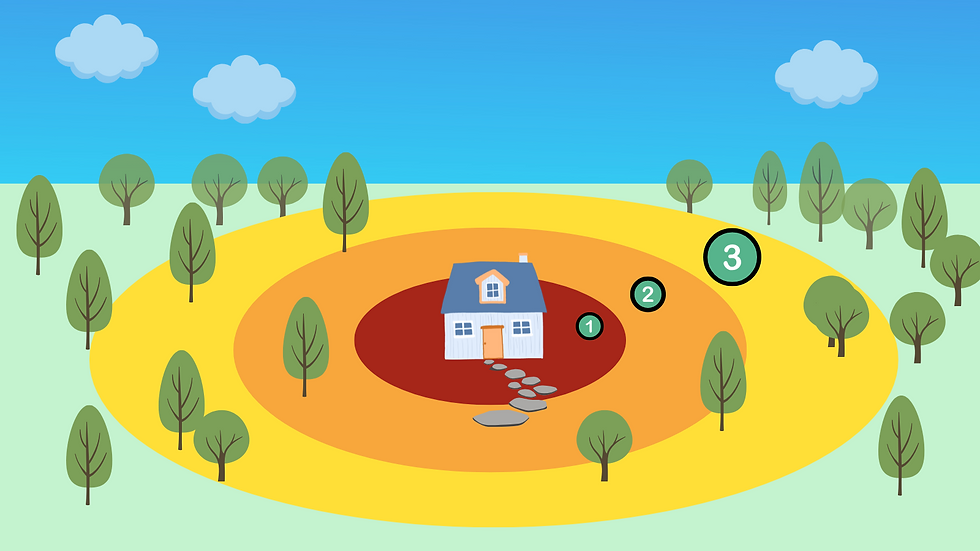
The Home Ignition Zone is a buffer of up to 200 feet around your house. It is the defensible space that you can cultivate as a safety bubble to protect your home. Maintaining the Home Ignition Zone can slow or stop the spread of wildfire, defend your house from fire and embers, and protect firefighters who are working to save your home.
The Home Ignition Zone requires regular, ongoing maintenance to be effective. Trees, grasses and shrubs continue to grow, die and drop leaves each season, and there are ongoing maintenance needs for any structures on your property. Follow these steps to maintain the home ignition zone. Take these practical steps to increase the likelihood your home survives a wildfire.

1. Immediate Zone
0-5 Feet from the furthest attached exterior point of the home; defined as a non-combustible area. Science tells us this is the most important zone to take immediate action on as it is the most vulnerable to embers. Start with the house itself, then move into the landscaping section of the Immediate Zone.
Clean roofs and gutters of dead leaves, debris and pine needles that could catch embers.
Replace or repair any loose or missing shingles or roof tiles to prevent ember penetration.
Reduce embers that could pass through vents in the eaves by installing 1/8 inch metal mesh screening.
Clean debris from exterior attic vents and install 1/8 inch metal mesh screening to reduce embers.
Repair or replace damaged or loose window screens and any broken windows Screen or box-in areas below patios and decks with wire mesh to prevent debris and combustible materials from accumulating.
Move any flammable material away from wall exteriors – mulch, flammable plants, leaves and needles, firewood piles – anything that can burn. Remove anything stored underneath decks or porches.
2. Intermediate Zone
5-30 Feet from the furthest exterior point of the home. Landscaping/hardscaping- employing careful landscaping or creating breaks that can help influence and decrease fire behavior
Clear vegetation from under large stationary propane tanks.
Create fuel breaks with driveways, walkways/paths, patios, and decks.
Keep lawns and native grasses mowed to a height of four inches.
Remove ladder fuels (vegetation under trees) so a surface fire cannot reach the crowns. Prune trees up to six to ten feet from the ground; for shorter trees do not exceed 1/3 of the overall tree height.
Space trees to have a minimum of eighteen feet between crowns with the distance increasing with the percentage of slope.
Tree placement should be planned to ensure the mature canopy is no closer than ten feet to the edge of the structure.
Tree and shrubs in this zone should be limited to small clusters of a few each to break up the continuity of the vegetation across the landscape.
3. Extended Zone
30-200 feet from the home. Landscaping – the goal here is not to eliminate fire but to interrupt fire’s path and keep flames smaller and on the ground.
Dispose of heavy accumulations of ground litter/debris.
Remove dead plants and tree material.
Remove small conifers growing between mature trees.
Remove vegetation adjacent to storage sheds or other outbuildings within this area.
Trees 30 to 60 feet from the home should have at least 12 feet between canopy tops.
Trees 60 to 100 feet from the home should have at least 6 feet between the canopy tops.

Sources: nfpa.org, wfca.com, csfs.colostate.edu


Comments